



Fingerprint biometrics
The fingerprint identification algorithms developed by Neurotechnology have achieved some of the highest reliability ratings in major biometric competitions and evaluations, including the National Institute of Standards & Technology (NIST) Minutiae Interoperability Exchange III, Proprietary Fingerprint Template Evaluation III, and Fingerprint Vendor Technology Evaluation for the US Department of Justice.
The algorithm is based on deep neural networks and follows the commonly accepted fingerprint identification scheme, which uses a set of specific fingerprint points (minutiae) along with a number of proprietary algorithmic solutions that enhance system performance and reliability. They include rolled and flat fingerprint matching, compact fingerprint templates, tolerance to fingerprint translation, rotation as well as deformation, and others.
Additionally, fingerprint liveness detection and quality checks help to avoid spoofing attempts.
Technology evaluations and awards
Neurotechnology's fingerprint recognition algorithms have received numerous awards in competitions and technology evaluations since 1998.
MINEX evaluations by NIST
- MINEX III evaluation was successfully passed in 2015. VeriFinger algorithm is part of the MegaMatcher technology, which was tested by NIST. In 2019 Neurotechnology's fingerprint template generator algorithm has been ranked the first in the NIST MINEX interoperability category; the fingerprint matching algorithm has also been ranked as the front-runner in terms of interoperability and, when combined, the two have become the supreme accuracy, high speed fingerprint recognition system. See our comments on MINEX III participation for more details about the results.
- MINEX Ongoing evaluation was successfully passed in 2014. The second place in the Ongoing MINEX ranking for fingerprint matching algorithms was achieved. VeriFinger algorithm as part of the MegaMatcher technology was recognized by the NIST as fully MINEX compliant. Read more.
FVC-onGoing results
In 2020 Neurotechnology's fingerprint recognition algorithm has shown the top result at the FVC-onGoing evaluation. The fingerprint extractor and matcher, which are included in VeriFinger SDK as part of the MegaMatcher technology, were ranked as the most accurate for both FV-STD-1.0 and FV-HARD-1.0 benchmarks. Our press release has more information.
PFT II and PFT III (Proprietary Fingerprint Template) Evaluations
- PFT III – in 2024 Neurotechnology's fingerprint recognition algorithm has shown again the most accurate results in most of the experiments at the PFT III. See our comments for more information.
- PFT II – the algorithm submissions showed the best overall template matching accuracy at the previous PFT II evaluation. The PFT II has ended in 2019.
SlapSeg III Evaluation
Neurotechnology's slap fingerprint segmentation algorithm showed off as a top performer in the SlapSeg III evaluation, featuring the fastest performance and almost the best accuracy in most categories of the SlapSeg III evaluation. See our comments for more information.
FpVTE (Fingerprint Vendor Technology Evaluations) by NIST
- FpVTE 2012 – in 2015 NIST recognized Neurotechnology's fingerprint identification algorithm as one of the fastest and most accurate among the evaluation's participants. See our comments on FpVTE 2012 participation for more details about the results.
- FpVTE 2003 – one of the best reliability results in the Middle Scale Test were shown. Neurotechnology participated in FpVTE 2003 under the name Neurotechnologija. See the FpVTE 2003 web site for a detailed report of the evaluation results.
WSQ 3.1 Certification by the FBI
In 2011 FBI certified Neurotechnology's implementation of WSQ image format support. Certificates and additional information are available.
FVC2006, FVC2004, FVC2002 and FVC2000 results
Neurotechnology participated in the Fingerprint Verification Competition several times and won numerous medals for reliability and performance. See the FVC2006 participation results, as well as FVC2004, FVC2002 and FVC2000 results for more information.
Products
Neurotechnology offers these fingerprint identification products:
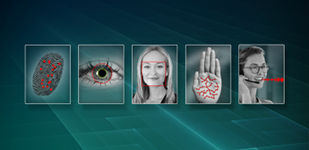
Designed for development of large-scale single- or multi-biometric fingerprint, iris, face, voice or palmprint identification products.
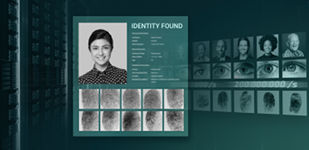
Solution for large-scale AFIS or multi-biometric systems. Provides high-performance biometric template matching on server-side.
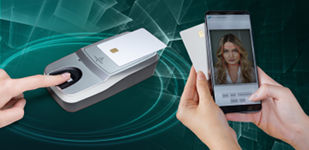
Multimodal biometric on card comparison.
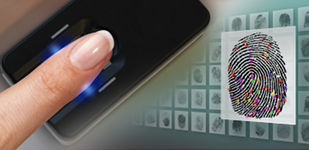
Fingerprint identification for stand-alone or client-server systems.
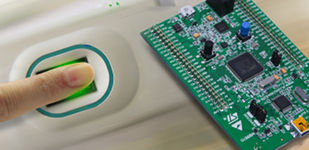
Fingerprint identification for embedded platforms.

Identity authentication using contactless fingerprint biometrics for secure mobile applications
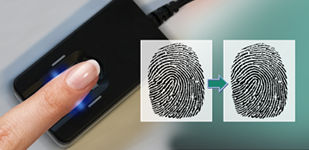
Freeware SDK and .NET components.

All-in-one solution for employee and visitor registration. Access control for persons and vehicles.


